|

|
|

April
2014
Important: To ensure future delivery of
the Policetraining.net newsletter to your inbox (not bulk or junk folders)
please add our "From" address
info@policetraining.net to your address book or e-mail whitelist.
|
- Sponsored By -
 |
|
 |

How
to 'Speak' Autism - Part 2: The First Wave
|
|
|
By Joel Lashley
Reprinted from Correctionsone.com
'Autism tsunami': 1 in 150 births are
currently on the autism spectrum; 3 out of 4 are male; half
are nonverbal or profoundly verbally limited. They are seven
times more likely to encounter the police than a person who
is not diagnosed with an Autism Spectrum Disorder (ASD).
Driven by the natural desire to connect with their sons and
daughters with autism, parents work tirelessly to
communicate, mostly through trial and error. When my
autistic son was growing up, this trial and error was just
about all we had to rely on. But now things are swiftly
approaching a critical mass. Parents of "the first wave" are
trying to pass on what we've learned to the next generation
of mothers and fathers — as well as the police and
corrections officers who will undoubtedly come into contact
with autistic people, and for whom mental health and autism
training is increasingly critical.
By "first wave" I am
referring to the massive increase of young adults with
autism; a statistical wave created by what appears to be a
perfect storm scenario of concurrent contributing factors,
including increased diagnoses, increased incidence of
autism, over-taxed and drying up community resources and a
maturing front-line demographic of individuals with
autism.
Just last May, I was invited by NEMRT (North East
Multi-Regional Training) to attend a police instructor
certification training seminar called "Autism Awareness and
Roll Call Briefing Trainer" in Chicago. The State of
Illinois has wisely joined Indiana and Kentucky in requiring
autism awareness and related subject control training for
its sworn law enforcement personnel. The conference was well
attended by academy instructors and police crisis
intervention team members, of the Chicago Police Department
and various other police instructors from throughout
Illinois.
The autism tsunami
The class was led by Dennis Debbaudt, the premier autism and
law enforcement issues expert who authored the book, Autism,
Advocates, and Law Enforcement Professionals; Recognizing
and Reducing Risk Situations for People with Autism Spectrum
Disorders. In my opinion, all first responders, parents of
children with autism, and persons on the autism spectrum,
should read his book. (For more information on classes,
please visit Autism Risk & Safety Managment.)
Mr.
Debbaudt’s co-presenter, Dr. Stephen Shore, is author of the
book, Beyond the Wall: Personal Experiences with Autism and
Asperger Syndrome, and co-author of the Dummies series book,
Understanding Autism for Dummies. (Also visit
www.autismasperger.net.) During his presentation, Dr. Shore
referred to the first wave phenomenon as the "autism
tsunami." He estimates the average age of these
autism-boomers at somewhere between 17 and 19 years of
age.
Consider this: the Center for Disease Control
estimates 1 in 150 births currently are on the autism
spectrum and possibly still rising. 3 out of 4 are male.
Half are nonverbal or profoundly verbally limited. They are
seven times more likely to encounter the police and at least
three times more likely to be victims of violent and/or
sexual crimes. 4 out of 5 police calls will involve unusual
or dangerous, not criminal, behaviors that will often be
difficult to manage or interpret. Two out of 5 will be prone
to seizures, and a good deal of them will be hypotonic
(low-muscle-tone), making them prone to positional asphyxia
and musculoskeletal injuries. To top it all off, many of
them will appear to be oblivious to pain, while others will
shrink, as if in pain (perhaps real pain), to your slightest
touch.
28 principles to guide you
In the previous article, I tried
to build a picture of recognition for subjects who may have
an intellectual or developmental disorder, including autism.
Once you've encountered a subject who you think might have a
cognitive impairment, here are a few principles to help you
out.
1. First be safe. Use your Verbal Judo principles of SAFER®
and make sure they are unarmed.
2. Persons with ASD are as diverse as neurotypical people
are. People with autism are as varied in levels of
intelligence, language ability, and personality as anyone
else. Start out simple. Then find out how well they can
communicate and adapt to that level.
03. Manage your back-up. Make sure you have back-up because
you may need them just like on any other call. Have your
back-up stay back a few extra feet and stay quiet. Their
presence is added stimulation you don’t need right then!
They should be alert, out of direct sight, and out of mind.
4. Don't interfere with "self-stimming."
Everyone
self-stimulates — we drum our fingers, tap our feet, and
other quirky things when under stress or just bored. Since
their sense of nonverbal communication is not like ours,
persons with autism will exhibit what looks like bizarre
self-stimulating behaviors, like hand flapping, twirling
their body, rocking, jumping in place, handling an object
and other things. Stimming can also be auditory in the form
of humming or other sounds by mouth, or repeating a single
work in rapid succession, "Yes, yes, yes, yes, yes."
Stimming is a natural behavior we all do to calm ourselves
down or focus our concentration. Let it go and keep talking.
It's helping you out more than you know.
5. Move them away from the scene, or move the scene away
from them. The point is to reduce outside stimulation. Give
them less of everything — less sound, less light, fewer
words, fewer voices, fewer people, fewer distractions.
Radios, sirens, pagers, beeping medical equipment, flashing
lights and all the trappings of public safety and emergency
medicine are exactly what will send your subject with autism
into crisis.
6. Allow for acclimation. Once you've moved them, allow them
to acclimate. Everyone "acclimates" to new surroundings. We
simply look around the room. People with autism will often
walk around the room touching things. Just watch and make
sure they are safe.
7. Don’t expect eye contact or other appropriate body
language. Their lack of, or some might argue "unique" sense
of, instinctive nonverbal communication will be unnerving.
They usually won't look at you or wear an appropriate
expression. They may spontaneously smile, frown, scowl, or
wear a blank expression. Don’t look for too much meaning in
what you see on the face.
8. Don't equate the inability to speak with deafness or
illiteracy. Even if your subject is nonverbal, they are
likely to hear and understand some or all of their own
primary language (English/ Spanish/ etc.). In the case of
nonverbal subjects with autism, your spoken commands may be
your only means of communication. Most of them can probably
read. Try short written notes if your spoken words aren't
"getting through."
9. Don't read meaning into words alone. Gauge your success
by their physical responses to your commands, not their
words. If you ask them to sit, they might say the word "sit"
before or after they physically comply. They might say,
"Starbucks" because their mother always tells them to sit
down during their daily trip to Starbucks. They may talk
about something seemingly way off topic, like a TV show or
their favorite restaurant.
They may repeat what you say
back to them. Immediate repetition of what another person
has said or is saying — a behavior called "echolalia" — is a
common autistic trait. Repeating is thought to be their way
of attempting communication with others from behind the
curtain of the profound loneliness many of them feel.
They
also might answer yes then no to the same question. Higher
functioning individuals might quote the law to you when you
are interfering, in their mind, with their right to move
freely. Be prepared to read between, over, and under, the
lines.
10. Use a normal volume of voice until you gauge their
reaction. If your voice appears to startle or frighten them
then decrease your volume. If your first attempts to
communicate have failed, you can try increasing your volume
slightly. Sensory input is often impaired. A low volume may
be expectable, while a "normal" volume might hurt their
ears. Or they might be hearing impaired, like my son, Colin.
You’ll have to be adaptable until you get things rolling.
11. Keep your tone of voice soft and unthreatening. They
will likely not be able to interpret emotion from your
voice, but in case they can, you want to sound
unthreatening. Slow your pace and speak clearly.
12. Use an economy of words. Keep your commands brief,
clear, and literal (no figures of speech). Speech is a form
of stimulus. Persons with autism and/or persons in crisis
abhor strange voices and sound. Only one responder should do
the talking and don’t allow unnecessary talking around the
subject.
13. Give them extra time. The persons with autism will
usually need more time to process your words and react to
them. Silently give them up to 11 seconds to act or respond
to your commands or questions. You can go onto the next
thing once they’ve answered you.
14. Dispel their fear. They don’t know what you want from
them. All they know is that you are in their face. Tell
them, "I am here to help you," "I will take care of you," or
"I will take you home," depending on the situation.
Anticipate the problem and alleviate their anxiety.
15. Say "good job" to kids and adults alike. This is
something I learned from Clinical Nurse Specialist Norah
Johnson, RN, in Education Services at, Children’s Hospital
of Wisconsin, with whom I’ve partnered in developing
behavior challenges training related to patients with autism
spectrum disorders. It may sound odd to say “good job” to an
adult, but it represents praise they likely to be familiar
with from childhood and perhaps even in their current living
situation. By praising them with the phrase “good job”
you're building rapport and validating for them that they
are doing what you want.
16. Use unthreatening body language. If they are able to
interpret body language, and most will not be able too, they
will not respond to your command presence. Most will not
understand it and some will only feel threatened by it.
Remember, you were trained to use a command presence as a
means to gain compliance. Your command presence, or alpha
posture, is not appropriate to use for persons with autism
or anyone in crisis. It will most likely only backfire on
you.
Instead of a command presence, keep your hands at
belt level, gesture slowly, and move slowly. Be relaxed but
alert.
17. Model the behaviors you want to see. Persons with
developmental disabilities may not understand the subtleties
of most nonverbal communication, but they usually will
respond to your mood and the gross-motor movements of your
body — either negatively or positively.
So, if you want
them to be still, then be still. If you want them to be
calm, then be calm. Want them to stay back then maintain an
appropriate space from them and from your partners. If you
want them to sit then try modeling sitting. Just as they
might echo your words, they might echo your behaviors.
18. Personal space is relative. Stay out of tip-off or
kicking range as trained. Proxemics is a form of nonverbal
communication like any other body language. Since persons
with autism spectrum disorders often do not have an
instinctive sense of personal space, they might invade
yours. Be ready for it. Guard your weapons. They can be
attracted to shiny or otherwise interesting objects. If you
have foreknowledge of what you’re getting into, then leave
your badge, name tags, pens, and other non-essential items
in your squad. Keep your hands empty — there will be time
for notes later.
19. Look for a cause. In my experience I’ve met kids with
autism who did things like put their head through a bus
window because they couldn’t tell anyone they had a bad ear
infection. I’ve met some who severely slapped their own bare
skin, probably just because they were cold. When I covered
them with a blanket the behavior stopped. I’ve seen kids who
were combative just because they were hungry. A cup of
applesauce can make acting-out behaviors disappear
magically.
Many teachers have talked about the "terrible
hour" meaning that time in the afternoon when some kids with
autism will act-up. Often when a brief nap was introduced,
the behaviors ceased. First see to basic needs: pain, cold,
heat, thirst, hunger, and fatigue, and then see what
happens.
20. Striking out is communication. Facial expressions and
other body language have limited or no meaning to persons
with an ASD. If we get to close, or come up behind a person,
we can expect to get a dirty look over the shoulder. The
dirty look means “stay back” and is often an unconscious and
instinctive, rather than learned, behavior. For persons with
autism, that instinct will often translate into a backhand
or choking movement. They can’t say it with their mouth, or
show it on their face, so their instinct is to physically
strike out with their hands.
21. Tell them the "rules." This is a tip I got from Dr.
Steve and Dennis Debbaudt — when I did, it was like a light
bulb went off over my head. People with autism are all about
routine and the "rules." Law-abiding neurotypicals, like you
and me, fear and/ or respect the law. Persons with ASD rely
on and respect the rules. So for example, say, "Sir, the
rules say I have to put these handcuffs on you."
22. Quiet hands and feet. "Quiet hands" is a common command
used to manage children with ASD in the home and school
setting. Its one many children and adults will be familiar
with. If one is striking out or kicking, try the "quiet
hands" or "quiet feet" command in a stern moderate tone.
23. Biting is a common defensive behavior — don't get
bitten! Biting is a common defensive behavior — don't get
bitten! Biting is probably the most basic mammalian
defensive reaction. When attempting to physically control
persons on the autism spectrum, stay clear of the mouth. The
human bite is very dangerous and I’ve seen persons with
autism severely bite their own loved ones. The best defense
against a bite is to prevent it by stabilizing the subject’s
head before the subject’s teeth can make contact with your
body. If you do get bitten, mandibular or hypoglossal
pressure points are worth a try, but I’ve seen them fail on
a subject with autism. In the event that they are severely
biting someone, there are other passive techniques for
breaking off a bite that are beyond the scope of this
article. But considering that biting is a common behavior
for autistic persons in crisis, it may be time for public
safety people to learn additional passive bite releases.
24. They have an alternative sense of fear. People with
autism may exhibit an irrational fear of, or be attracted
to, glass. They are often attracted to bodies of water and
have no fear of drowning (I taught my son to swim at a young
age, and I suggest it to everyone. Work with his or her
doctors and learn how to proceed). Certain sounds and sights
may frighten them, perhaps even some odors or textures, but
at the same time they might have no fear of opening a door
in a moving car or darting into heavy traffic. Wandering off
is a big problem with ASD kids and some adults. A lack of
fear of strangers, places them in all sorts of dangerous
situations.
25. They have an altered sense of pain. Many persons on the
autism spectrum can be repulsed by certain textures and
calmed by others. Irritation from certain fabrics has been
described, by some persons with autism, as painful. They
might have a broken arm or other severe wound and not
exhibit a pain response, such as screaming, crying, or
guarding. Some may be comforted by a bear hug, but the same
person might shriek at a soft touch on the shoulder, as if
in pain.
26. Pain compliance will not work reliably, either because
they can’t feel it, or because they can’t make the causal
connection between your actions and the pain. For instance,
they likely won’t get the connection between their action
(biting) and your action (pressure point). Rapid Multiple
Officer Stabilization involving the manual control of the
limbs, e.g., Star Tactic (biting caution) and the
blanket-escort hold, is your best method of controlling the
actively violent unarmed subject that you suspect might have
autism. Wrist compression come-along tactics may injure the
subject without ever achieving the desired result of
compliance. When you “crank down” on the wrist, they might
not wince or cry-out even if you break their wrist! They are
also hypotonic making them more susceptible to injury from
wrist compression. Children and elderly subjects are also
very susceptible to this type of injury. A baton strike may
be useful as a means of disarming or creating dysfunction,
should such a level of force become necessary. Be prepared
for a baton strike to fail as a method of pain compliance or
psychological control. Be ready to change your method and/or
level of force quickly, depending on the circumstances.
An
initial TASER® Probe Deployment will likely cause momentary
incapacitation, creating a short window of opportunity in
which officers can quickly move in and stabilize an autistic
subject armed with an edged or blunt force weapon. Remember,
one must presume that pain compliance resulting from a drive
stun with the cartridge removed will be unsuccessful. Again,
persons with autism may even feel the pain intensely without
making the causal connection between his action (holding a
weapon or potential weapon) and the pain created by your
drive stun without the cartridge. They also may not
understand that a TASER® is a weapon. If the subject with
ASD fails to comply when you point a gun, TAZER®, OC
canister or other weapon at them it could be for several
reasons, such as: A.) They don’t understand what the weapon
can do or even recognize it as a weapon. B.) They need
several seconds (up to 11 or even 15 on average) for them to
understand that you are pointing a weapon at them, C.) They
don’t care that you are pointing a weapon at them because
they are in crisis. If your subject has an altered sense of
pain, OC Spray will also likely fail as a means of control.
Remember that they are likely to be hypotonic and have
respiratory problems already. Consider that before using
pepper spray. As one firefighter/paramedic put it too me
recently, “Once the cops pepper spray an autistic guy or
maybe someone with a diabetic reaction, and nothing happens,
they usually call us to handle it. No big deal.” Pardon me
if I prefer that officers not use their pepper spray as an
assessment tool. Take your time and be ready to “change
gears” when you think you have a subject with special needs.
An officer must always do what they must to protect
themselves or others. By having a thorough knowledge of what
you’re up against, your actions will have a better chance of
a successful outcome for both you and your subject with
autism. When responding to calls involving subjects with
autism, 4 out of 5 times you’ll be handling a subject in
crisis who is scared and/or lost, not a criminal. Questions
regarding the use of pain compliance techniques, control
devices like OC Spray, Electronic Control Devices, and
impact weapons on special needs subjects should be discussed
with your department experts on the use of force and the
individual weapon systems involved.
27. Support and constantly monitor breathing. Because they
are often hypotonic, they often have difficulty breathing
under stress. Also, their chest muscles may be weak and have
difficulty supporting even their own weight, in some
positions. Position your handcuffed subject on their side in
the lateral recumbent (low-level fetal) position, meaning
slightly bent at the waist and knees. If it’s safe, sit them
up. Consider transporting them in the lateral recumbent
position in an ambulance. Every cop knows about positional
asphyxia. Consider all your subjects with developmental
disabilities to be at risk.
28. Adrenaline stays up. Whether for organic or behavioral
reasons (and I’ve been told by experts that it’s one, the
other, or both) persons with autism need lots of extra time
to cool down. It’s just like any other person in crisis. If
you’re sick of waiting, then get ready to fight. Then get
ready to explain yourself. As public safety professionals,
the academic evidence is against us. What we do next at the
scene of a person in crisis, or potential crisis, will
usually determine if the situation is resolved peacefully or
not — not the subject.
The good news is, as a parent of a child with autism, and
someone who’s worked and trained with street cops for most
of my professional life, I know that cops are very good at
sizing up these situations. Give them the tools and they’ll
know what to do with them! If the pros can provide police,
corrections, and healthcare security officers with the
necessary tools to recognize and communicate with subjects
likely to have ASD, then the situation will have a fighting
chance to resolve peacefully. A police and corrections
officers' ability to influence the lives of others is
enormous. Your proper handling and reporting of persons with
ASD could have the power determine their destiny for the
better — just as the improper handling will have the equal
ability to injure them — even ruin their lives and your
career. That, officers, is a tremendous responsibility. It
is a responsibility as great as the responsibility for the
proper execution of force, perhaps even lethal force. The
power of a single police encounter has the ability to change
a life forever. At no time is this more the case, then when
dealing with persons in crisis, whether they have autism or
not.
Special thanks to Lt. Dave Nickels with the Appleton, WI
Police Department and a TASER Senior Master Instructor.
Error! Hyperlink reference not valid.
About the author
Joel Lashley has worked as a public safety professional for
25 years, including 17 years of service in the health care
setting. Joel leads the training program for hospital,
clinical, and social outreach staff in Violence Awareness,
Prevention, and Management at Children’s Hospital of
Wisconsin in Milwaukee, the only level 1 pediatric trauma
center in the region, serving critically injured and ill
patients throughout the Mid-West
He has trained hundreds of nursing, clinical, social work,
psychiatric, and public safety professionals in the
management and prevention of violence. He is a certified
instructor for Interventions for Patients with Challenging
Behaviors and Principles of Subject Control (POSC®) –
Security Personnel, and Non-violent Crisis Intervention®,
from the Crisis Prevention Institute. He is a member of the
International Association for Healthcare Security and Safety
and the International Association of Non-violent Crisis
Intervention Certified Instructors.
Joel has developed a program for managing the care of
children, adolescents, and adults with autism and other
cognitive disabilities. The fact that his son has autism has
made him concerned about how this segment of our population
is managed in the medical, security, and law enforcement
arenas. Future articles deal with this and other issues
facing our medical and mental health facilities as we search
for ways to best treat their patients.
.
|
|
Fitness Tip from

Split your workout into 10 or
15 minute sessions to fit it into your day. Plus, split workouts may
provide an extra post workout burn of 10-15 extra calories as
compared to doing your workout all at once.
Click here to find out the details, and learn how many minutes
are really needed for health benefits and weight loss..
How To Start a Tactical Team
|
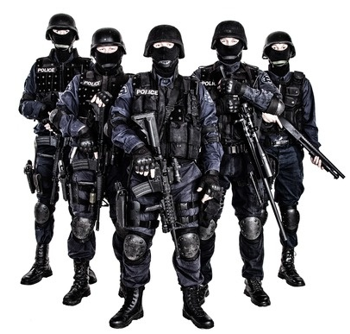 Want
to form a tactical team? Read on. Want
to form a tactical team? Read on.
by William Harvey Reprinted from Police Magazine
Put
yourself in this situation, you are a senior officer in a
small- to medium-sized department. You don't have a tactical
team. If you needed one, maybe the state would respond. But
things are changing and your chief (or sheriff) calls you
into their office and tasks you to start up an
active-shooter response team or a rapid deployment team for
your department. Where do you begin?
First and foremost, get clear direction from your leader.
What is their definition of what you are to design? What are
their desires? What is the department's commitment? Do you
want a high-risk warrant team, an active-shooter response
team or a Level II SWAT team? What do they envision and have
the fortitude for? What will be the budget? How much
latitude will you have to do what is right, safe and
logical? Now you have clear directions to work with what are
the next steps.
Next, contact your state's tactical officer association;
most have one that will be a wealth of information. Be sure
to contact the National Tactical Officers Association—a
benchmark with information, trainers, and training. Listen
to their guidance. They will provide regional resources you
can meet with and recommendations.
If your region has a terrorism task force, reach out to
them. They may offer training, networking, and funding
opportunities. There are several outstanding tactical
training companies out there. Make sure you vet them. There
are several "swatologists'' who lack creditability and
undercut reputable offerings. Paying a high price won't
ensure quality.
As you start out, there are three components you need to
focus on throughout—people, policy and equipment. The people
component will be the size and staffing requirements; listen
to your advisors. They will explain not only the number
required, but the commitment of personnel along with the
physical and training requirements. Many may apply; few
could be disappointed; and some need not apply. It sounds
cool to be on "the team," but can you do the job?
The policy side of this is where your state tactical
association or other state professional organizations
(chiefs, sheriffs and training council) will help. Often you
can take a worthy and similar-sized agency's policies for a
base foundation. Don't just cut and paste! Make sure that
your agency has parallel supportive polices and no conflicts
with other standards and policies. I would also recommend
that they are from your state; each state has different
nuances in their laws, so avoid this conflict. This short
cut will get you into trouble, so review it with your
accreditation manager or departmental policy writer.
Equipment sounds like the cool part, but requires a lot of
planning and thought process. Look again at how other teams
are equipping theirs and listen to their recommendations.
Some product lines may have changed and others may be more
suitable, so do your research. Make an effort to attend the
state or regional tactical officers' or SWAT conferences. I
prefer to pick up, touch and try on some products rather
than ordering from a catalog. This area can also be the
budget buster, so review all selections and make the right
(often tough) decisions.
This is the first phase of team formation. It's not just
gathering up a group, getting fancy tactical dress, and
heading out for some shooting. This is a process that's
applicable to the formation of any specialized team. There
are more behind-the-scenes preparations needed before
calling for volunteers that I will address in a future
column.
|
10 Truths of Police Training
|
PoliceOne
Columnist Richard Fairburn’s excellent piece titled 10
truths of police leadership inspired me to ponder what
“truths” police trainers need to think about
By Betsy Brantner Smith
Last week, my fellow PoliceOne Columnist Richard
Fairburn wrote an excellent piece titled 10 truths of
police leadership.
I sent it to many of my friends, posted it on Facebook
and Twitter, and printed it out to hang in my office.
In fact, it inspired me to ponder what “truths” police
trainers need to think about, so with gratitude to my
fellow trainer Fairburn, here are my “10 truths of
police training.”
1.) Training isn’t about the teacher, it’s about the
student. Evaluate your motives. Ask yourself why you’re
a trainer (or want to become one) and be honest in your
answers. You’re not there to show your students what an
amazing stud or stud-ette you are — your job is to make
them believe they are the biggest badass in the room
(and on the street).
Reevaluate your training continuously. Are you striving
toward your goals and completing your objectives or just
doing drills, biding time? Are you staying current,
working hard to innovate? Minimize the war stories and
make sure they have a training point. Above all, check
your ego at the door; it’s not your classroom, it’s
theirs.
2.) Your job is to change behavior, not judge people.
I’m guessing most of your students aren’t as well-read,
motivated or as fit as you are. That’s unfortunate (and
it can be frustrating) but you are not there to look
down on them, you’re there to lift them up. I know a
trainer who mocks her students and co-workers behind
their backs, calling them “lowest common denominators.”
If they are not SWAT material and don’t run marathons.
Your job is to make them want to improve and give them
the tools and knowledge to be successful. Consider your
worst student your own personal challenge to improve
your skills as a trainer and motivator.
3.) A good trainer is ethical. Keep your resume and your
vitae factual. We all know people who exaggerate, but
lying about your education, your experience or your
training is unacceptable. I used to work with a guy
whose resume and war stories kept changing and expanding
to try and keep up with his total lack of substantive
training ability.
There’s no excuse for this in our profession, but
unfortunately it’s not uncommon. Be honest, be ethical.
4.) A trainer who has nothing left to learn needs to
retire. Coach Bob Lindsay — the 2013 ILEETA “Trainer of
the Year” — has been in police training for more than 50
years. I’ll never know half of what he’s already
forgotten, and yet he is constantly seeking, growing and
learning and I’m guessing he will never stop.
The best trainers are always students first.
5.) You can’t substitute talent with technology. I love
to have videos and music and all the other bells and
whistles in my presentations; it’s fun for me and I
think its fun for my students. However, be prepared for
none of it to function properly. I once watched my
husband talking to more than 500 cops in an officer
survival seminar held in a Las Vegas casino ballroom.
With 45 minutes to go, the power went out.
As soon at the emergency lighting came back on, he
continued talking — no videos, no computer, no
microphone. The only thing he did was raise his voice
slightly. He had them laughing and crying — as usual…and
they gave him a thundering standing ovation. It wasn’t
until that day that I understood what he had been
telling me for years: “Computers are great but a real
trainer should have the same impact without the
technology.”
6.) No man (or woman) is a prophet in their own land. I
laughed when I read this same point in Dick’s article —
the same is so true in police training. I meet so many
highly skilled and talented trainers (and writers too)
who are either ignored, or worse, vilified by their own
agencies.
People may be threatened by your talent or success, or
they may be envious, and envy is a powerful thing.
What can you do? You can either keep trying to push your
agency to accept you as a trainer, or you can learn to
let it go; it’s your decision. Just remember, the
department doesn’t “owe you” the privilege of training
your peers, you have to earn it, and you probably have
to earn it “their way,” at least in the beginning.
7.) You can’t replace information with laughs. There’s
no doubt about it, humor and emotion intensify learning.
I like to be funny in class, and I’m married to a guy
who is actually successful at it. However, is your class
an eight-hour comedy show, or is it valid training and
information?
The training principle behind the JD Buck Savage officer
survival videos was to help officers retain the training
points through humor. Yes, it’s fun to laugh, but it’s
much better to laugh and learn.
8.) Training your peers is a privilege. Standing before
your fellow officers or co-workers should never be taken
lightly; it’s an incredible privilege. You are always a
role model, and often you are a modeling the future
desired behavior of your students.
Check your attitude and your behavior, watch your
language, and make sure your information is accurate and
timely. Train safe and avoid artifacts (are you still
shooting at the seven, fifteen and twenty-five yard line
without cover?) And if you feel the need to put other
people down to enhance your own training, you need some
serious self-reflection.
9.) Ask for help, but do your own work. At almost every
class we teach someone asks us for a copy of our
presentation. Often we get email from people asking us
for our research, all of our video clips, or a job. Some
of these people have a sincere desire to solve a problem
in their agency, present new training to a group, or
start a police training career, they just don’t know
where to begin. We are happy to provide resources and
suggestions, and we’re honored to be asked, but don’t
expect other people to do your work for you.
We brought another instructor into our cadre last year.
She’s talented and funny, has a great resume and
outstanding experience. But what sealed the deal is when
I asked her if she was interested in working with us,
and she didn’t ask for anything other than advice.
She did her own research, developed her own program,
sought out feedback (and took it to heart) and made
continual improvements. Ask to be mentored, seek out
trainers you admire or enjoy, but don’t expect an
intellectual handout.
10.) Give credit where credit is due. Every great
trainer stands on the shoulders of another. But if
someone — a co-worker, a trainer, an author — has given
you great insight (or more), the professional thing to
do is to give them credit. It’s the right thing to do.
We should all be trainers with the same basic goal, to
improve this profession and keep each other healthy,
successful, and above all, safe!
About the author
Sergeant Betsy Smith has more than 30 years of law
enforcement experience, retiring as a patrol supervisor
in a large Chicago suburb. A graduate of the
Northwestern University Center for Public Safety's
School of Staff and Command and a Street Survival
seminar instructor for more than 9 years, Betsy is now a
speaker, author and a primary PoliceOne Academy
consultant. Visit Betsy's website at
www.femaleforces.com.
Image credit: zabelin / 123RF Stock Photo
|
(MCTC,
NCTC, RCTA, WRCTC, MCTFT)
The counterdrug training academies and their
FREE Training are going to be shut down for the rest of this year,
or most likely forever, if we (law enforcement officers) do not help
out immediately! Please copy and paste the below message and send
it to your Congressional Representatives and Senate Representatives
immediately. It would greatly help if you would also send it
to every Congressional Representative listed at the end of this
(MCTC, NCTC, RCTA, WRCTC, MCTFT)
March 3, 2014
Dear (Congressman/Senator)
Image credit: zabelin / 123RF Stock Photo
< < jump to the policetraining.net home
page>
|
|
